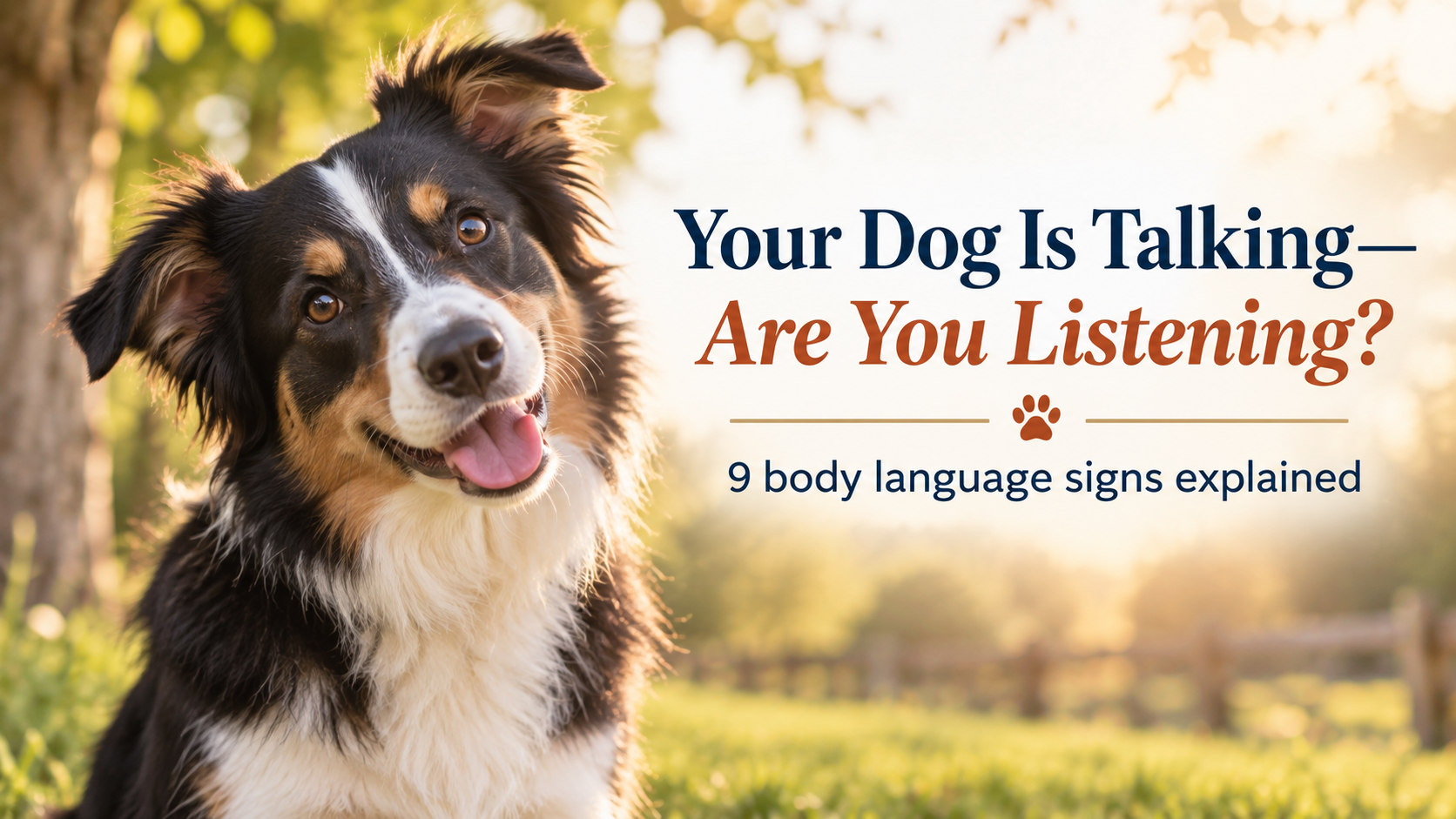
Your dog may not speak English, but that does not mean they are quiet.
Dogs are communicating with us constantly. They use their eyes, ears, tails, posture, facial expressions, movement and even the way they position themselves next to us to say things like:
“I’m happy.”
“I’m not sure about this.”
“Please give me a little space.”
“I trust you.”
“Can we leave now?”
Also, “I noticed you opened the cheese drawer.”
The problem is that humans tend to pay attention to the obvious signals — barking, growling, jumping, tail wagging — while missing many of the smaller clues that happen first.
Learning how to read dog body language can help you understand when your dog feels relaxed, excited, nervous, uncomfortable or deeply connected to you.
And once you start noticing these little signals, you may realize your dog has been having entire conversations with you all along.
Here are nine important dog body language signs worth paying attention to.
1. The Whole-Body Wiggle
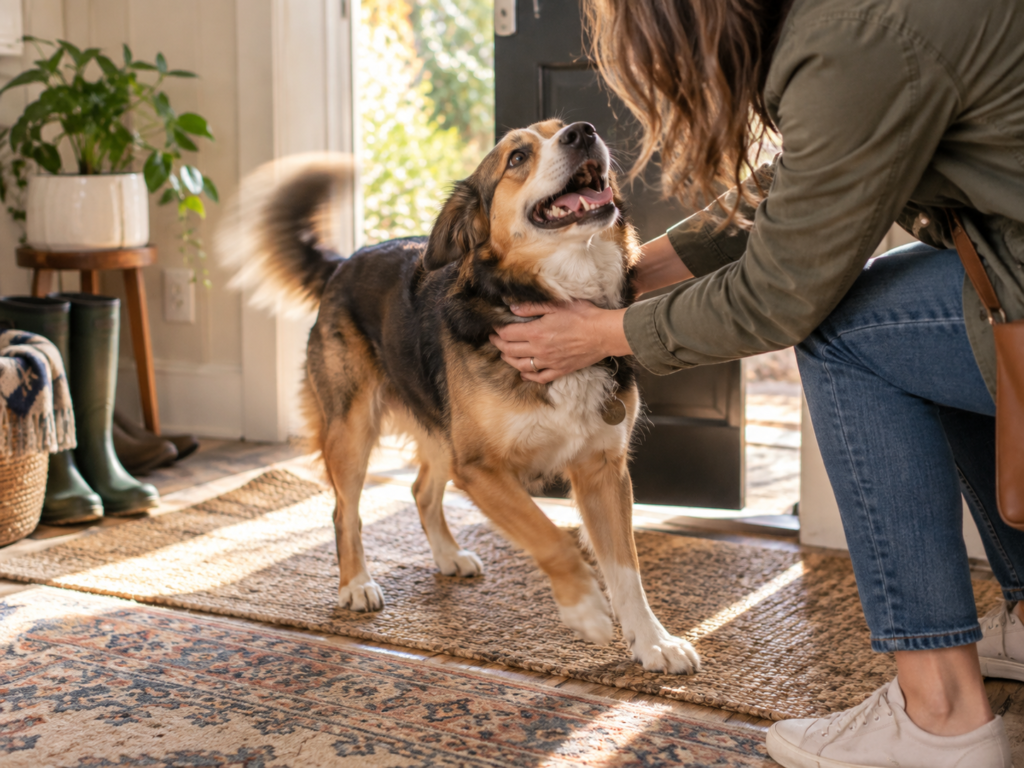
Few things are better than walking through the door and being greeted by a dog whose entire body seems to have turned into a noodle.
A loose, wiggly body is generally a good sign.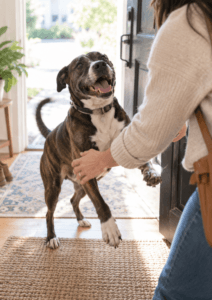
When a dog is comfortable and happy, you may see relaxed muscles, soft movements, an open mouth and a tail that moves along with the rest of the body.
Some dogs wiggle so enthusiastically that their backside appears to be operating independently from the front half.
That is quite different from a dog who is standing stiffly.
A stiff body, frozen posture or very controlled movement can indicate uncertainty, tension or discomfort — even if the dog’s tail happens to be moving.
That is why one of the biggest lessons in understanding dog body language is this:
Never judge your dog by one body part alone.
Look at the entire dog.
2. A Wagging Tail Does Not Always Mean “I’m Happy”
This is one of the most common dog body language myths.
Most of us were taught:
Wagging tail = friendly dog.
But a wagging tail really tells us that a dog is emotionally activated. The dog may be excited and happy, but they could also be uncertain, alert or overstimulated.
Look at how the tail is moving and what the rest of the dog is doing.
A relaxed dog may have a loose, sweeping wag accompanied by a soft body and relaxed facial expression.
A dog holding their tail high and stiff while making short, rapid movements may be feeling much more alert or tense.
A tucked tail can signal fear, nervousness or discomfort.
Even breed and anatomy matter. A naturally curled tail looks very different from the tail of a Labrador or Greyhound.
So instead of automatically thinking, “His tail is wagging, so everything is fine,” ask:
What is the rest of my dog saying?
That one question can completely change the way you read dog behavior.
3. Soft Eyes Can Be a Sign of Comfort and Trust
Your dog’s eyes can tell you a surprising amount.
When dogs are relaxed around someone they trust, their eyes often appear soft rather than wide or intensely focused.
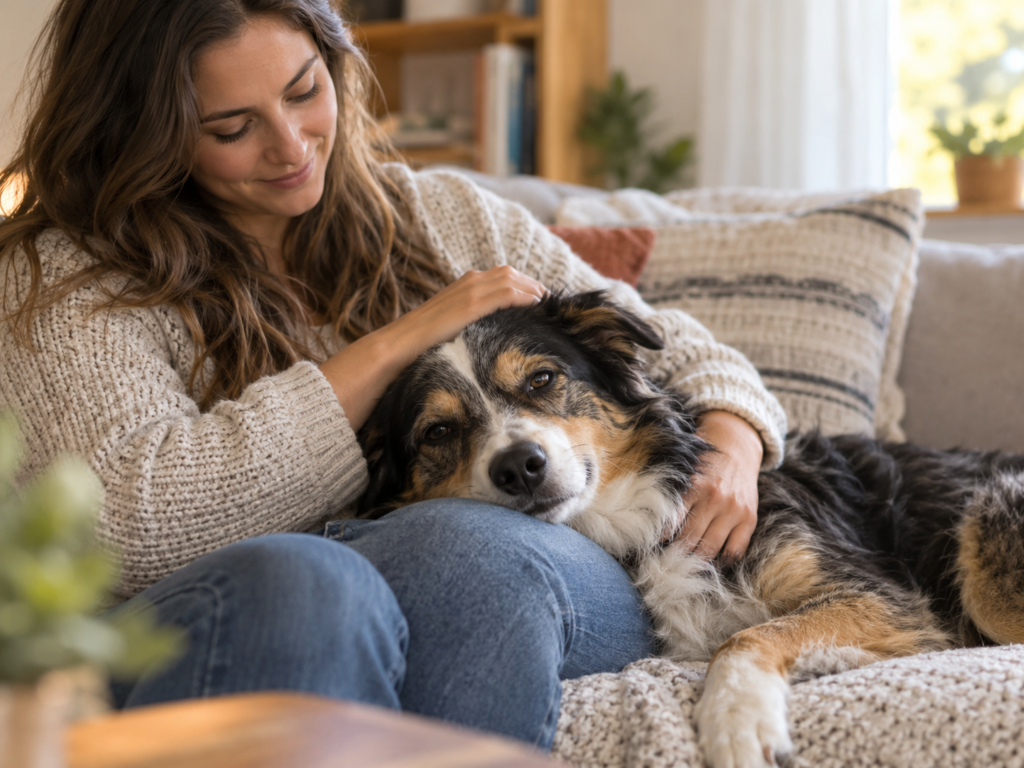
You may notice slow blinking, partially closed eyelids or a relaxed expression while your dog is lying near you.
That peaceful look your dog gives you from across the couch?
It may be one of those small moments that shows your dog feels comfortable in your presence.
Dogs also pay close attention to our faces and eyes, so communication between dogs and humans can be surprisingly subtle.
But there is an important opposite signal to recognize.
If a dog suddenly becomes still and you can see a large amount of the white portion of their eye — sometimes called “whale eye” — it can indicate that the dog is uncomfortable or worried.
Context matters.
A dog lying upside down being silly may briefly show the whites of their eyes. A dog guarding a toy while freezing and showing the whites of the eyes is telling you something very different.
Eyes should always be read along with posture, movement and the situation around the dog.
4. Leaning Against You Can Be a Sign of Connection
Does your dog ever walk over and casually press their entire body against your leg?
Some dogs are world-class leaners.
They may sit on your foot, push against your knee or somehow manage to occupy 80 percent of the couch while technically only touching you with one shoulder.
For many dogs, voluntarily choosing close physical contact is a sign that they feel safe and comfortable with you.
Dogs are social animals, and proximity can be meaningful.
That does not mean every dog expresses affection by cuddling, though.
Some dogs want to be practically attached to their humans.
Others show trust by simply choosing to sleep a few feet away.
A dog who does not enjoy hugging or constant touching can still be incredibly bonded to you.
The important clue is choice.
If your dog regularly chooses to sit near you, lean against you or rest beside you when they could be somewhere else, that may be one of the quiet signs your dog trusts you.
Want to Understand Your Dog Even Better?
Reading your dog’s body language is a great start. The next step is learning how to communicate in a way your dog understands, too.
K9 Training Institute offers a free dog training workshop with practical techniques you can start using with your dog right away.
Watch the Free Dog Training Workshop →
Affiliate disclosure: I may earn a commission if you purchase through this link, at no extra cost to you.
5. Yawning Does Not Always Mean Your Dog Is Tired
Dogs yawn when they are sleepy.
But that is not the only reason.
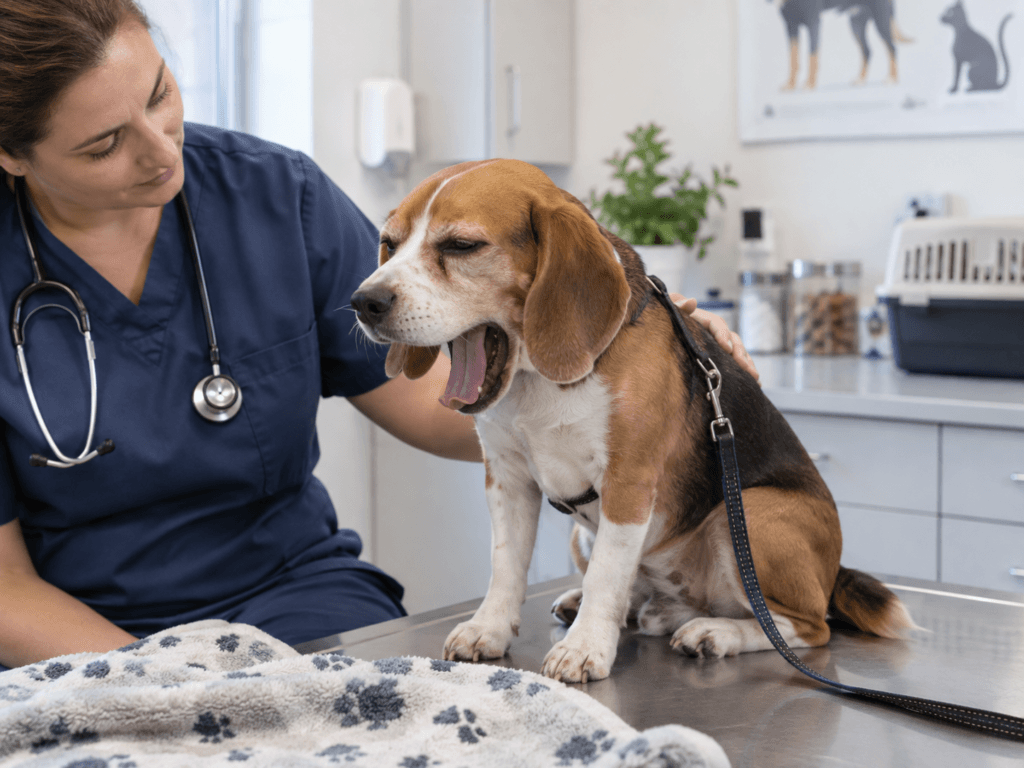
Yawning can also appear when a dog is experiencing mild stress, uncertainty or emotional tension.
For example, you might see your dog yawn:
- at the veterinarian’s office
- during a training session
- when meeting someone new
- when being hugged or handled
- in a noisy or overwhelming environment
This is where dog body language gets interesting.
A behavior that means one thing in one situation can mean something completely different in another.
A dog yawning at 10 p.m. while curled up in bed?
Probably tired.
A dog repeatedly yawning while turning their head away from an unfamiliar person who keeps reaching toward them?
That deserves more attention.
Your dog may be communicating:
“I’m not completely comfortable with this.”
Recognizing these quieter signals can help you respond before your dog feels the need to communicate more dramatically.
6. Turning Away Can Actually Be Communication
Humans often assume that if a dog turns their head away, they are ignoring us.
Dogs may see it differently.
Turning the head, looking away or briefly moving the body away can be part of a dog’s way of reducing tension.
You may notice this when someone gets very close to your dog’s face, when another dog approaches or when your dog is unsure about a situation.
Instead of thinking:
Why won’t you look at me?
Consider:
Is my dog asking for a little breathing room?
One of the easiest ways to become better at reading your dog is to respect subtle communication.
If your dog looks away, backs up or moves away from an interaction, allowing them some space can help build trust.
Your dog learns:
“I can communicate, and my person listens.”
That is a pretty powerful relationship builder.
7. Bringing You Things May Mean More Than “Throw This”
You are sitting peacefully.
Your dog appears.
They are carrying a sock.
Or a toy.
Or something they absolutely were not supposed to find.
What now?
Sometimes the message is obvious:
PLAY WITH ME.
But bringing objects to you can also be part of social interaction.
Your dog may be initiating play, seeking attention or simply wanting to share an activity with you.
Some dogs greet their favorite people by grabbing the nearest toy and proudly carrying it around.
Others bring toys directly to their humans.
And some dogs proudly present household objects like tiny furry criminals who would like recognition for their work.
The object itself is not always the important part.
The important part may be:
Your dog chose to involve you.
That is one of the reasons seemingly silly dog behaviors can tell us a lot about the relationship dogs have with their humans.
8. Following You Around May Be a Sign of Bonding — But Watch the Context
Kitchen.
Bathroom.
Laundry room.
Bedroom.
Back to the kitchen because apparently you forgot why you went there.
And behind you?
Your dog.
Many dogs like staying close to their favorite people because they enjoy companionship and want to know what is happening.
Following you around can be a perfectly normal sign of attachment.
Some dogs also perform little “check-ins.”
They may be relaxing in another room, wander over to see what you are doing, and then return to their favorite spot.
That can be a lovely sign of security.
But constant following can sometimes have another explanation.
If your dog becomes distressed whenever you leave, cannot settle without you, paces, vocalizes or shows destructive behavior when alone, the issue may go beyond simple affection.
As with all dog behavior, context matters.
There is a difference between:
“You are my favorite person, and I want to see what you’re doing.”
and
“I feel unsafe when I cannot be near you.”
Learning your dog’s normal patterns makes it easier to recognize when something changes.
9. Your Dog Walking Away Is Still Talking
This may be one of the most important dog body language signals of all.
If your dog gets up and walks away from an interaction, let them.
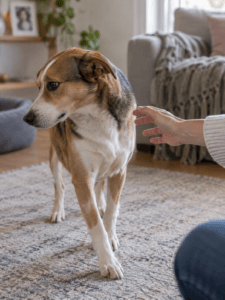 Dogs should be allowed to say “no thanks.”
Maybe they have had enough petting.
Maybe the kids are being loud.
Maybe they do not want their paws touched.
Maybe they simply want to nap somewhere else.
Walking away is a wonderfully polite form of communication.
Problems can happen when those early signals are repeatedly ignored.
A dog may first:
look away.
lick their lips.
yawn.
move backward.
walk away.
freeze.
growl.
If the quieter signals never work, some dogs eventually learn they need to communicate more strongly.
That is why growling should not automatically be treated as a dog being “bad.”
A growl is information.
Your dog is telling you they are uncomfortable.
The better we become at noticing the whispers, the less likely our dogs are to feel like they need to shout.
The Secret to Reading Dog Body Language: Look at the Whole Picture
There is no single gesture that translates perfectly every time.
A tail wag does not always mean happiness.
A yawn does not always mean stress.
Following you does not automatically mean separation anxiety.
Showing the whites of the eyes does not automatically mean fear.
Dog behavior makes the most sense when you look at three things together:
The dog.
The environment.
What happened immediately before the behavior.
Think of dog body language less like translating individual words and more like reading a sentence.
One signal gives you information.
Several signals together give you context.
And the more familiar you become with your own dog’s normal behavior, the easier those conversations become to understand.
Your Dog Has Probably Been Talking to You All Day
Once you start watching closely, you may notice dog communication everywhere.
The relaxed sigh when your dog settles beside you.
The little glance back during a walk.
The toy dropped at your feet.
The head turn when something feels uncomfortable.
The full-body celebration when you come home after being gone for approximately seven minutes.
None of these behaviors exists in isolation.
Together, they create a language.
And learning that language can do more than satisfy our curiosity.
It can help us recognize stress earlier, respect our dogs’ boundaries, build trust and better understand the animals sharing our homes.
Your dog does not need words to tell you how they feel.
They have been talking all along.
The real question is:
Are you listening?
Your Dog Is Learning From You Every Day 🐾
The question is: are you both speaking the same language?
Discover simple training techniques designed to improve communication, behavior and the bond you share with your dog.
Affiliate disclosure: I may earn a commission if you purchase through this link, at no extra cost to you.
Stay curious. Stay kind.